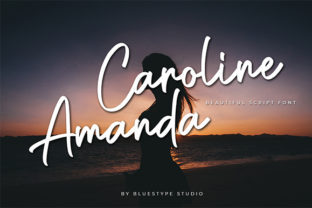
Caroline Amanda Font Review
It was a quiet Saturday morning, and I found myself standing at my desk with a fresh batch of soy candles ready for labeling. As I reached for my design tools, I thought about how the right font could elevate these simple jars from ordinary to elegant. That’s when I pulled up Caroline Amanda, a sweet script typeface that feels like it was made just for moments like this.
Caroline Amanda for Candle Labels and Handmade Packaging
Caroline Amanda is a Script Handwritten font that brings a personal touch to every project. I tested it on candle labels, and the result was immediately charming. The soft curves and gentle strokes gave each label a handcrafted feel, perfect for small-batch products. It worked beautifully on both white and kraft paper, and even when I used it on a sticker sheet for a seasonal gift set, the font maintained its clarity and warmth.
For handmade packaging, Caroline Amanda adds a sense of authenticity that customers appreciate. Whether I was designing a tag for a soap bar or a box for a custom gift, the font felt right. It’s not overly ornate, which means it can be used without overwhelming the design. But it still has enough character to make a statement.
Caroline Amanda for Greeting Cards and Wedding Stationery
I also tried Caroline Amanda on a wedding invitation mockup. The font paired well with a clean sans serif for the details, letting the script take center stage for names and titles. It added a romantic, personal vibe that fit the occasion perfectly. The font’s legibility made it easy to read even in smaller sizes, which is a big plus for stationery where space can be limited.
For greeting cards, Caroline Amanda works best for short phrases—like “Thank You” or “Happy Birthday.” It doesn’t lend itself to long paragraphs, but that’s okay. Its charm is in the way it feels handwritten, making it ideal for decorative wording rather than dense text.
Caroline Amanda for Digital Printables and Shop Branding
As a printable creator, I often look for fonts that are versatile and easy to use. Caroline Amanda fits the bill. I used it in a digital printable wall art design, and it brought a soft, inviting energy to the piece. The font’s natural flow made it feel like it was written by hand, which is exactly what I wanted for a cozy home decor theme.
When it comes to shop branding, Caroline Amanda can help create a cohesive look across product listings, social media graphics, and packaging. It pairs well with other Script Handwritten fonts or bold display fonts for contrast. Just be sure to check the font’s licensing if you’re planning to use it commercially.
Caroline Amanda for Boutique Tags and Seasonal Crafts
I also tested Caroline Amanda on a set of farmhouse-style signs and holiday tags. The font looked great on both wood and metal surfaces, adding a vintage, artisanal feel. For seasonal crafts, it’s a go-to for anything from Christmas card designs to Easter egg labels. It’s especially useful when you want to keep things simple but still stylish.
One thing to note is that while Caroline Amanda is readable in most cases, it may not be the best choice for very tiny cuts or dense label information. If you’re using it with a Cricut or Silhouette machine, make sure to test it at the size you plan to cut. The font holds up well at medium sizes, but very small text might lose some of its detail.
Caroline Amanda for Merchandise and Apparel
For merchandise like mugs, shirts, and tote bags, Caroline Amanda adds a personalized flair that makes products stand out. I designed a custom tote bag with a name and a short phrase, and the font looked great in both large and small sizes. It worked well with a minimalist background, letting the script shine without competing with other elements.
When pairing Caroline Amanda with other fonts, I found that a simple serif or sans serif complemented it nicely. This helps balance the design and keeps it from feeling too busy. It’s also a good idea to check the font’s file formats and multilingual support if you’re planning to sell internationally.